Travelling to the United Arab Emirates is easier when you know a few basic Arabic phrases. Although English is widely used in hotels, shopping malls, restaurants and tourist areas, learning simple Arabic words can make everyday interactions more enjoyable.
You do not need to become fluent in Arabic before visiting the UAE. Knowing how to say hello, thank you, please, how much and where can help you communicate politely with local people and understand common expressions.
The UAE has its own spoken Arabic varieties, including Emirati Arabic. However, many standard Arabic phrases are widely understood. This guide introduces useful UAE Arabic phrases for tourists, with English meanings and simple pronunciation to help you practise before your trip.
Is Arabic Necessary for Tourists in the UAE?
No. Tourists can generally manage many everyday situations using English, particularly in major cities such as Dubai and Abu Dhabi.
English is commonly used in:
- Hotels and accommodation
- Shopping malls and retail stores
- Airports and tourist attractions
- Restaurants and cafés
- Many taxi and transport services
However, Arabic is the official language of the UAE and remains an important part of its culture and everyday life.
Using a few Arabic expressions can be a friendly way to show respect and make a positive impression. Even a simple greeting or thank-you can make an interaction feel more welcoming.
Basic Arabic Greetings for Tourists
Greetings are among the most useful phrases to learn before visiting the UAE. You can use them when entering a shop, meeting someone or starting a conversation.
| Arabic Phrase | Easy Pronunciation | English Meaning |
|---|---|---|
| السلام عليكم | As-salamu alaykum | Peace be upon you |
| وعليكم السلام | Wa alaykum as-salam | And peace be upon you |
| مرحباً | Marhaban | Hello |
| أهلاً وسهلاً | Ahlan wa sahlan | Welcome |
| صباح الخير | Sabah al-khayr | Good morning |
| مساء الخير | Masa al-khayr | Good evening |
| مع السلامة | Ma’a as-salama | Goodbye |
| كيف حالك؟ | Kayfa haluk? | How are you? |
How to Use Common Greetings
As-salamu alaykum: A respectful and widely used greeting. A common reply is Wa alaykum as-salam.
Marhaban: A simple way to say hello in everyday situations.
Sabah al-khayr: Use this greeting in the morning.
Masa al-khayr: Use it in the evening.
You do not need to use every greeting in one conversation. One appropriate greeting is enough to begin politely.
Essential Arabic Words You Should Remember
Some short Arabic words are useful in almost every travel situation. Learning these first can make it easier to understand basic conversations.
| Arabic | Pronunciation | English Meaning |
|---|---|---|
| نعم | Na’am | Yes |
| لا | La | No |
| شكراً | Shukran | Thank you |
| عفواً | Afwan | You are welcome / Excuse me |
| من فضلك | Min fadlak | Please |
| آسف | Aasif | Sorry |
| جيد | Jayyid | Good |
| حسناً | Hasanan | Okay |
| ممكن | Mumkin | Possible / Can I? |
| لا أفهم | La afham | I do not understand |
Useful tip: If you remember only three words before your trip, start with Shukran, Min fadlak and Afwan. They can be useful in many everyday interactions.
Arabic Phrases for Shopping in the UAE
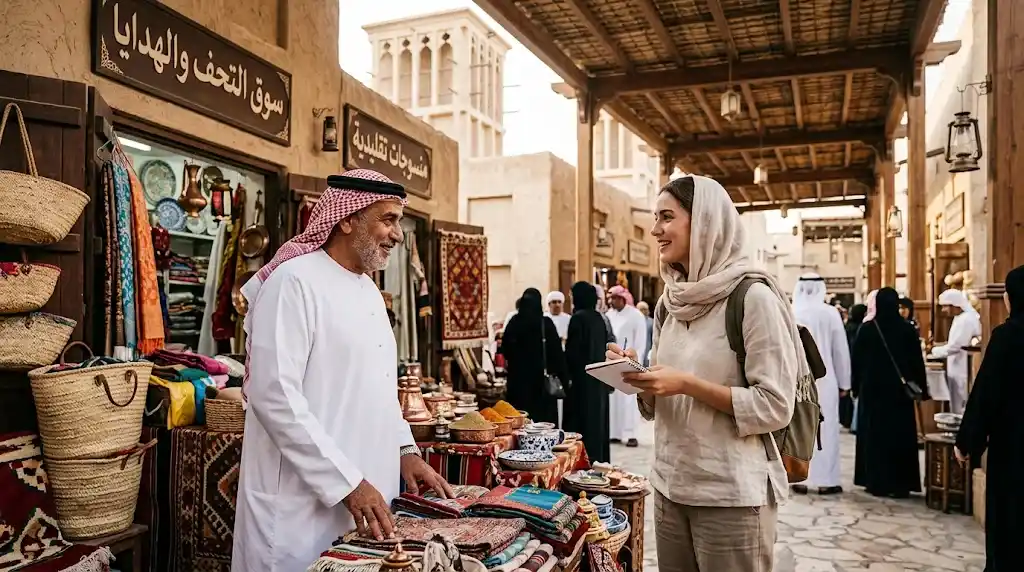
The UAE is a popular shopping destination, with large malls, traditional markets and independent shops. Basic Arabic shopping phrases can help you communicate with shopkeepers.
| Arabic Phrase | Pronunciation | English Meaning |
|---|---|---|
| بكم هذا؟ | Bikam hadha? | How much is this? |
| كم السعر؟ | Kam as-si’r? | What is the price? |
| هل لديك مقاس آخر؟ | Hal ladayka maqas akhar? | Do you have another size? |
| هل يمكنني رؤية هذا؟ | Hal yumkinuni ru’yat hadha? | Can I see this? |
| غالي جداً | Ghalin jiddan | Very expensive |
| هل يوجد خصم؟ | Hal yujad khasm? | Is there a discount? |
| سأفكر في الأمر | Sa’ufakkir fil-amr | I will think about it |
| لا أريد | La urid | I do not want it |
Example Shopping Conversation
Here is a simple example of how a tourist might communicate with a shopkeeper.
Shopkeeper: Marhaban!
Tourist: Marhaban. Bikam hadha?
Shopkeeper: The shopkeeper tells you the price.
Tourist: Hal yujad khasm?
Meaning: Is there a discount?
These expressions are useful in shops and traditional markets. If the conversation becomes complicated, you can politely switch to English.
Arabic Phrases for Restaurants and Cafés
Restaurants in the UAE serve a wide range of local and international food. These phrases can help when asking for a menu, ordering food or requesting the bill.
| Arabic Phrase | Pronunciation | English Meaning |
|---|---|---|
| قائمة الطعام من فضلك | Qa’imat at-ta’am min fadlak | Menu, please |
| أريد الماء | Urid al-maa | I want water |
| أريد القهوة | Urid al-qahwa | I want coffee |
| ماذا تنصحني؟ | Madha tansahuni? | What do you recommend? |
| هل هذا حار؟ | Hal hadha harr? | Is this spicy? |
| بدون سكر | Bidun sukkar | Without sugar |
| الحساب من فضلك | Al-hisab min fadlak | The bill, please |
| شكراً جزيلاً | Shukran jazilan | Thank you very much |
Useful Phrases for Food Preferences
If you have specific food preferences, these expressions may help:
- Ana nabati: I am vegetarian. (A simple phrase; explain your dietary requirements clearly.)
- Hal fihi lahm? Does it contain meat?
- Hal fihi jaban? Does it contain cheese?
- La urid al-har: I do not want spicy food.
For food allergies, do not rely only on a short translated phrase. Explain the allergy clearly and ask restaurant staff to confirm the ingredients and food preparation.
For more ideas about local dishes, read our UAE Food Guide for Tourists.
Arabic Phrases for Taxis and Public Transport
Tourists often need to ask drivers for directions or explain where they want to go. These phrases can help with simple transport conversations.
| Arabic Phrase | Pronunciation | English Meaning |
|---|---|---|
| أريد الذهاب إلى… | Urid adh-dhahab ila… | I want to go to… |
| أين محطة المترو؟ | Ayna mahattat al-metro? | Where is the metro station? |
| أين موقف الحافلات؟ | Ayna mawqif al-hafilat? | Where is the bus stop? |
| توقف هنا من فضلك | Tawaqqaf huna min fadlak | Stop here, please |
| كم يستغرق الوصول؟ | Kam yastaghriq al-wusul? | How long does it take to arrive? |
| هل هذا قريب؟ | Hal hadha qarib? | Is this nearby? |
| أين الطريق؟ | Ayna at-tariq? | Where is the road? |
Example: Asking for a Metro Station
Tourist: Excuse me, Ayna mahattat al-metro?
Meaning: Where is the metro station?
Other person: They may explain the direction or point towards the station.
If you are travelling around Dubai, our Dubai public transport guide can help you understand the main transport options.
Arabic Phrases for Hotels and Accommodation
You may need to communicate with hotel reception staff when checking in, asking about facilities or requesting assistance.
| Arabic Phrase | Pronunciation | English Meaning |
|---|---|---|
| لدي حجز | Ladayya hajz | I have a reservation |
| أريد تسجيل الدخول | Urid tasjil ad-dukhul | I want to check in |
| أين غرفتي؟ | Ayna ghurfati? | Where is my room? |
| أين المصعد؟ | Ayna al-mis’ad? | Where is the lift? |
| أحتاج إلى مساعدة | Ahtaj ila musa’ada | I need help |
| هل يوجد إنترنت؟ | Hal yujad internet? | Is there internet? |
| متى وقت الإفطار؟ | Mata waqt al-iftar? | What time is breakfast? |
Most hotel staff in tourist areas can communicate in English, so these phrases are optional but useful to know.
Arabic Phrases for Asking Directions
When exploring a new city, you may need to ask where a place is or understand basic directions.
| Arabic Phrase | Pronunciation | English Meaning |
|---|---|---|
| أين؟ | Ayna? | Where? |
| هنا | Huna | Here |
| هناك | Hunak | There |
| يمين | Yamin | Right |
| يسار | Yasar | Left |
| أمام | Amam | In front |
| قريب | Qarib | Near |
| بعيد | Ba’id | Far |
| هل يمكنك مساعدتي؟ | Hal yumkinuka musa’adati? | Can you help me? |
These words are especially helpful when someone is giving you simple directions.
Arabic Phrases for Emergencies
It is useful to know a few expressions for situations when you need assistance. Keep your phone charged and save important travel and accommodation details.
| Arabic Phrase | Pronunciation | English Meaning |
|---|---|---|
| ساعدني من فضلك | Sa’idni min fadlak | Please help me |
| أحتاج إلى طبيب | Ahtaj ila tabib | I need a doctor |
| أحتاج إلى الشرطة | Ahtaj ila ash-shurta | I need the police |
| اتصل بالإسعاف | Ittasil bil-is’af | Call an ambulance |
| أنا تائه | Ana ta’ih | I am lost (male speaker) |
| أنا تائهة | Ana ta’iha | I am lost (female speaker) |
| أين المستشفى؟ | Ayna al-mustashfa? | Where is the hospital? |
In a real emergency, contact the appropriate local emergency service rather than relying only on language phrases. If you cannot explain the situation in Arabic, use English or show your location and the relevant information on your phone.
How to Say Numbers in Arabic
Numbers can be useful when discussing prices, quantities, room numbers and shopping.
| Number | Arabic | Pronunciation |
|---|---|---|
| 1 | واحد | Wahid |
| 2 | اثنان | Ithnan |
| 3 | ثلاثة | Thalatha |
| 4 | أربعة | Arba’a |
| 5 | خمسة | Khamsa |
| 6 | ستة | Sitta |
| 7 | سبعة | Sab’a |
| 8 | ثمانية | Thamaniya |
| 9 | تسعة | Tis’a |
| 10 | عشرة | Ashara |
Practising these numbers can help you recognise simple prices and quantities. For larger amounts, it is perfectly acceptable to use the numbers displayed on a calculator or phone.
Are Emirati Arabic and Standard Arabic the Same?
Not exactly. Standard Arabic and spoken Emirati Arabic are related, but everyday pronunciation and vocabulary can differ.
Modern Standard Arabic is commonly used in formal writing, news and official communication. Emirati Arabic is a local spoken variety used in everyday conversations by many Emiratis.
For tourists, basic standard Arabic expressions are a useful starting point because many people will understand them. You may also hear local expressions that sound different from the phrases in this guide.
Do not worry if your pronunciation is not perfect. A polite attempt is often more important than speaking with a perfect accent.
Tips for Learning Arabic Before Your UAE Trip
You can learn a useful set of travel expressions without spending months studying the language.
Try these simple methods:
- Learn five phrases each day: Start with greetings, thank-you expressions and shopping words.
- Practise pronunciation aloud: Reading a phrase silently is not enough. Say it slowly several times.
- Save useful phrases on your phone: Keep a small list available when travelling.
- Learn words by situation: Practise restaurant phrases together and transport phrases separately.
- Listen to native pronunciation: Audio examples can help you understand sounds that are difficult to learn from English spelling.
- Use polite expressions: Words such as Shukran and Min fadlak can make basic interactions more courteous.
- Do not be afraid to use English: If you cannot understand a conversation, politely ask whether the other person speaks English.
Frequently Asked Questions
Do tourists need to speak Arabic in the UAE?
No. English is widely used in tourist areas, hotels, restaurants and shopping centres. However, learning a few Arabic expressions can make everyday interactions more enjoyable.
What is the most useful Arabic phrase for tourists?
Shukran, meaning thank you, is one of the easiest and most useful phrases to remember. As-salamu alaykum is also a widely used greeting.
How do you say hello in UAE Arabic?
Marhaban is a common Arabic greeting meaning hello. As-salamu alaykum is another widely used and respectful greeting.
How do you say thank you in Arabic?
Thank you is Shukran, written as شكراً.
Is English widely spoken in Dubai?
Yes. English is commonly used in many tourist areas, hotels, shopping malls, restaurants and transport services.
Can tourists use standard Arabic in the UAE?
Yes. Basic Modern Standard Arabic phrases are generally understood, although everyday Emirati speech may use different vocabulary and pronunciation.
How do you ask for the price in Arabic?
You can say Bikam hadha? meaning How much is this? Another option is Kam as-si’r? meaning What is the price?
Is Arabic difficult for tourists to learn?
You do not need to learn the entire language for a short trip. Starting with greetings, common words, numbers and basic travel questions is a manageable way to prepare.
Final Thoughts
Learning a few Arabic phrases before visiting the UAE can make your travel experience more comfortable and enjoyable. You can use simple expressions when greeting people, ordering food, shopping, asking for directions or requesting help.
English is widely used in tourist areas, so you do not need to worry about becoming fluent. Start with basic greetings and polite words, practise their pronunciation and keep a short phrase list on your phone.
Even a small effort to learn the local language can help you connect more positively with the culture and people of the UAE.