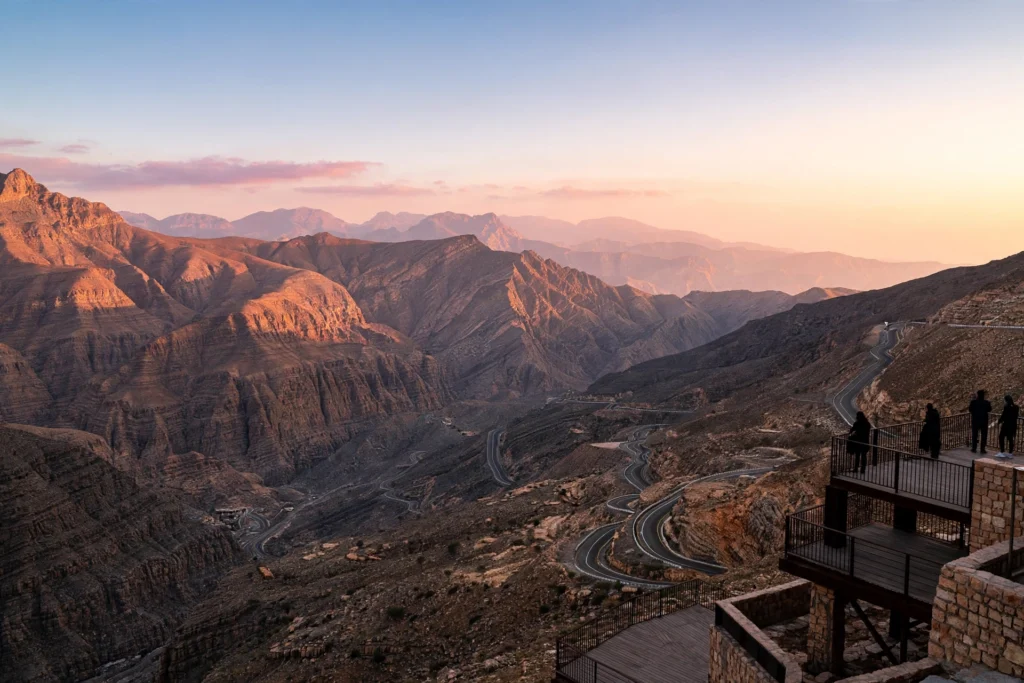
Jebel Jais is the highest mountain in the United Arab Emirates, and it is the one place in the country where the landscape stops looking like the desert you expect and starts looking like a proper mountain range. The peak rises to 1,934 metres in the Hajar Mountains of Ras Al Khaimah, and a single paved road winds nearly 30 kilometres up from the plains to a viewing deck park at 1,250 metres. Up there the air is around 10 degrees cooler than on the coast, the rock folds away into deep wadis, and on a clear day you can see the Arabian Gulf glittering on the horizon.
What makes Jebel Jais worth a day of your trip is that it is not one attraction but several stacked on the same mountain: a free scenic drive and viewpoint, the world’s longest zipline, a six-zipline sky tour, a mountain toboggan run, hiking trails, a Bear Grylls survival camp, and restaurants and cafes at altitude. You can spend nothing and still have one of the best views in the UAE, or you can book the zipline and have one of the most talked-about experiences in the country.
This guide covers the drive, the Viewing Deck Park, the zipline and the other activities, what everything costs, and the best time to go — including the price and hours disagreements you should know about before you set off.
Jebel Jais at a glance
- Where: Ras Al Khaimah, in the Hajar Mountains, about 45 minutes from Ras Al Khaimah city and around 2 hours from Dubai.
- Height: 1,934 metres — the highest peak in the UAE. The Viewing Deck Park sits at 1,250 metres.
- Entry: the mountain road and the viewpoints are free to drive. The Viewing Deck Park charges a small entry fee (see the conflict note below).
- The headline activity: the Jais Flight zipline — 2.83 kilometres long, the longest in the world, at speeds of up to 150–160 km/h.
- Best time: October to April, when daytime temperatures are pleasant and evenings are cool. November to March is the peak season.
- How long: half a day from Ras Al Khaimah, a full day trip from Dubai. Allow 1–2 hours at the viewing deck alone, longer if you hike or book an activity.
- Getting there: by car only — there is no public transport up the mountain. Renting a car or booking a tour are the realistic options.
If you are planning the wider trip, start with our guide to the best time to visit the UAE to see where Jebel Jais fits in your season, and our Ras Al Khaimah travel guide for what else to do in the emirate.
The drive up the mountain
The drive is half the experience. The Jebel Jais mountain road climbs from the plains near Wadi Shehah through a series of hairpin bends, with new viewpoints opening at every turn. The road is fully paved, well maintained and wide enough for two cars throughout, but it is steep and winding, so drive slowly and use the lay-bys rather than stopping on the bends. The climb takes about 30 to 45 minutes from the foot of the mountain, depending on traffic.
There is no public transport to the top, so you need your own wheels or a tour. From Dubai it is roughly a 2-hour drive via Sheikh Mohammed bin Zayed Road (E311) to Ras Al Khaimah, then the mountain road. From Ras Al Khaimah city it is about 45 minutes. If you are renting, our guide to renting a car in Dubai as a tourist covers the documents and the rules. Check the road status before you go: the mountain road can close in bad weather, and the operator’s website sometimes carries a maintenance notice. Fill up with fuel before the climb — there is no petrol station on the mountain — and carry water and a warm layer. Even on a hot day on the coast, the top can be windy and cool, and winter mornings at 1,250 metres can feel genuinely cold.
Jais Viewing Deck Park
The Viewing Deck Park is the mountain’s main viewpoint and the natural first stop. It is a set of landscaped terraces built into the mountainside at around 1,250 metres, with seven viewing decks, 12 fixed binoculars, shaded seating, benches angled towards the valleys, a children’s play area and parking. The views run across the folded limestone ridges of the Hajar range, down into deep wadis, and on clear days all the way to the coast. It is also the trailhead for the mountain’s hiking routes.
Here is the honest warning about entry and hours, because sources disagree. The official Jebel Jais website and most current guides list entry at AED 10 per person (including VAT) for a day ticket, with the park open Sunday to Thursday 8:00 AM to 8:00 PM and Friday to Saturday 8:00 AM to 11:00 PM. A few other guides describe the park as free and the road as open around the clock — which is true of the road itself, but the fenced Viewing Deck Park is the part with the fee. Older listings still show AED 7. Budget for AED 10 per person and check the official site on the day, because the fee and the hours have changed before. The park’s cafes — Puro Express and Muse Cafe — sell drinks and snacks, and there are restrooms on site.
Sunset is the best time at the deck: the low light turns the limestone gold and pink, and the temperature is at its most comfortable. Arrive at least an hour before sunset for a good spot, because the decks fill up on winter weekends. The park is also popular with stargazers after dark, thanks to the lack of city lights — another reason the Friday and Saturday late closing matters.
The Jais Flight zipline
The Jais Flight is the reason many people come to Jebel Jais at all. It is the world’s longest zipline: 2.83 kilometres of cable from a launch platform at around 1,680 metres above sea level, with riders lying flat in a “superman” harness and reaching speeds of up to 150–160 km/h (sources differ on the top speed — the operator says up to 150 km/h in some listings and 160 km/h in others). The flight takes about 2 to 3 minutes, which sounds short until you are doing it, and ends at a landing platform partway down the mountain, with a shuttle back to the top.
The price listed by the operator, Visit Jebel Jais, is from AED 325 per person, with lower seasonal offers at times. It runs Wednesday to Sunday and on public holidays, from 9:30 AM to 4:00 PM. Book through the official Visit Jebel Jais website — walk-up slots are limited and the zipline sells out on winter weekends. There are age, weight and health restrictions (check them when you book), and you should arrive at least 30 minutes before your slot. If the zipline feels like too much, the Jais Sky Tour is the gentler alternative: six ziplines totalling about 5 kilometres, linked by a sky bridge, at speeds of up to 60 km/h, taking around two hours. It is still a proper adventure, but you sit in a harness rather than flying face-down.
Jais Sledder, hiking and the Bear Grylls camp
The Jais Sledder is the mountain’s toboggan run — a bobsled-style track that winds down the mountainside, with riders controlling their own speed. It is a good middle option between the viewpoint and the zipline, and it works well for families. One caution: the operator’s website carried a notice in September 2026 that the Sledder was temporarily closed, so check its status before promising it to children.
Hiking is the other free draw. Several marked trails start from the Viewing Deck Park, including the popular route along the ridge and the longer trails into the wadis. The best hiking months are November to March; in summer, hike only at dawn. Take more water than you think you need, wear proper shoes, and do not hike alone on the longer routes. The mountain is also home to the Bear Grylls Explorers Camp, a survival camp with cabins and courses run by the Bear Grylls team — bookable for families and groups, and a genuinely different way to spend a night on the mountain.
There are also restaurants at altitude, including venues at around 1,484 metres, which makes lunch with a mountain view part of the day. They are popular at weekends, so book ahead if you want a table at sunset.
Best time to visit Jebel Jais
October to April is the season. Daytime temperatures at the top are pleasant, evenings are cool, and the skies are at their clearest. January to April and November to December are the most comfortable months, with April often rated the best single month. In summer the mountain is still cooler than the coast — roughly 10 degrees cooler — which makes it one of the few outdoor escapes in the UAE’s hottest months, but the midday sun is still fierce and the zipline and hiking are harder work. Winter mornings can be cold and windy, so bring a jacket even if you left Dubai in a T-shirt. The mountain is open all year, subject to road closures in bad weather, so a rainy day on the coast can mean a closed road up top — check before you set off.
What to bring and what it costs
A Jebel Jais day can cost almost nothing or several hundred dirhams, depending on what you book. The drive and the viewpoints are free; the Viewing Deck Park is around AED 10 per person; the Jais Flight is from AED 325; the Sky Tour and the Sledder cost extra on top. Food at the mountain cafes is priced like a tourist attraction, so budget for it or bring a picnic — there are shaded seating areas at the deck park.
Bring: a warm layer (even in summer), sun protection, more water than you expect, cash for small purchases (cards are widely accepted but cash is useful), and a charged phone or camera — the light at sunset is the best photography on the mountain. If you are combining the trip with other northern emirates, our 7-day UAE road trip itinerary shows how Jebel Jais fits into a longer drive. And if you want another mountain day, our Jebel Hafeet visitor guide covers the Al Ain peak, while the Hatta Dam guide and the Hatta Wadi Hub guide cover Dubai’s mountain escape. For desert contrast, our Dubai desert safari guide is the other classic UAE day out. Check the UAE weather guide for tourists before you pick your day, and our UAE travel photography guide for getting the most out of the mountain light.
Tips for first-time visitors
- Go for sunset, not midday. The light is better, the temperature is better, and the decks are at their best. Arrive an hour early.
- Book the zipline days ahead. Weekend slots sell out, and the online price is the one to trust — walk-up availability is not guaranteed.
- Drive slowly and use the lay-bys. The road is good but steep, and the views are a distraction. Pull over properly to take photos.
- Bring a jacket. The top is around 10 degrees cooler than the coast, and winter mornings at 1,250 metres are genuinely cold.
- Check the road and activity status the morning you go. Weather closures and maintenance notices happen, and the Sledder has been temporarily closed.
FAQ
Is Jebel Jais free to visit?
Driving the mountain road and stopping at the roadside viewpoints is free. The fenced Viewing Deck Park charges around AED 10 per person, and the zipline, sky tour, sledder and camp are paid activities booked separately.
How long does it take to get to Jebel Jais from Dubai?
About 2 hours by car to the foot of the mountain, plus 30 to 45 minutes up the mountain road. From Ras Al Khaimah city it is about 45 minutes to the foot of the mountain.
What is the Jais Flight zipline?
The world’s longest zipline: 2.83 kilometres from a launch platform at around 1,680 metres, with riders lying flat and reaching up to 150–160 km/h. It costs from AED 325 per person and runs Wednesday to Sunday, 9:30 AM to 4:00 PM.
What is the best time to visit Jebel Jais?
October to April, and especially November to March. Sunset is the best time of day at the Viewing Deck Park. Summer is cooler than the coast but still hot at midday.