Al Fahidi is the Dubai that existed before the towers. Tucked into Bur Dubai on the southern bank of the Creek, this small quarter of honey-coloured coral-stone houses and wind towers is the oldest surviving neighbourhood in the city — and it is free to walk through, open all day, and ten minutes by Metro from the Burj Khalifa. It is the single best place to understand what Dubai looked like before oil, and it is the natural starting point for a half-day in Old Dubai: the lanes, two small museums, a cultural centre, art galleries, and then an AED 1 abra across the Creek to the souks of Deira.
This guide covers the history, what to see inside the quarter, the honest warning about the Dubai Museum, the practical details — entry fees, hours, how to get there — and how to combine it with the Creek and the souks.
What is Al Fahidi?
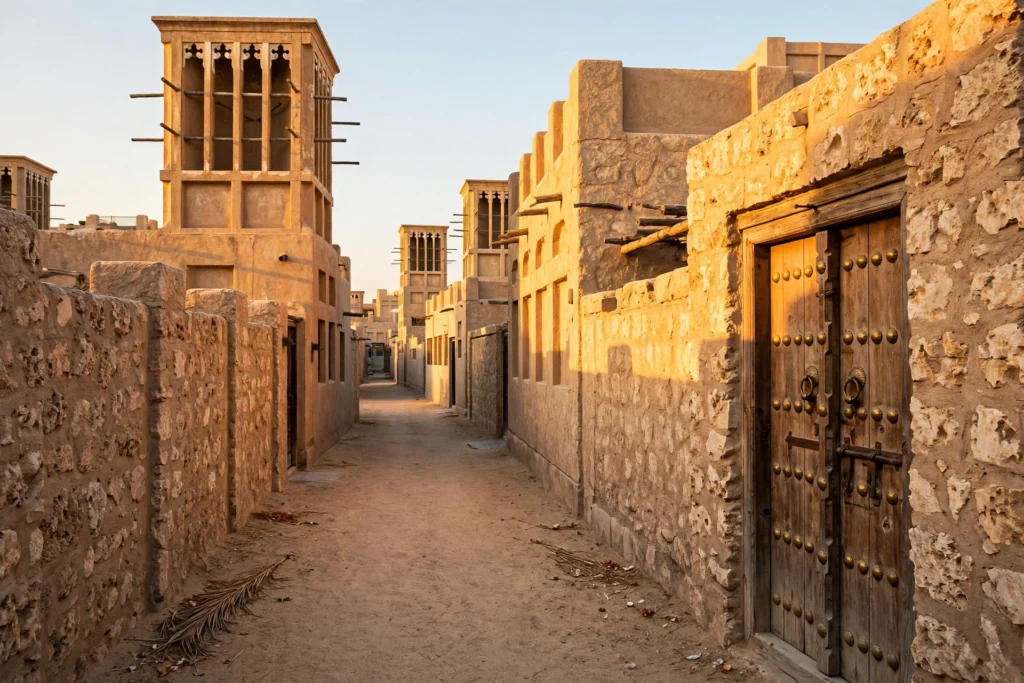
Al Fahidi Historical Neighbourhood — also known by its older name, Al Bastakiya — was built in the 1890s by wealthy Persian merchants who crossed the Gulf from the Bastak region of southern Iran to trade in pearls and textiles. At its height it held around 50 to 60 courtyard houses, built of coral stone, gypsum and teak, with the tall wind towers — barjeel — that were Dubai’s original air conditioning: they caught the breeze above the rooftops and funnelled it down into the rooms below.
The quarter survived the oil boom by luck and by campaigning: in the 1980s it was nearly demolished for a new development, and it was saved after a campaign led by a British architect and the intervention of the ruler. The houses were restored through the 1990s and 2000s, and today they hold museums, galleries, cafés and the Sheikh Mohammed Centre for Cultural Understanding. The lanes themselves are the attraction — narrow, sandy, quiet, and nothing like the rest of Dubai. For the wider Old Dubai picture, see our Old Dubai travel guide.
The lanes and the wind towers
Start by wandering without a map. The quarter is small enough that you cannot stay lost for long, and the best of it is found by accident: a carved wooden door, a courtyard glimpsed through a gate, a wind tower against the sky. The towers are the signature — Al Fahidi has the densest cluster of barjeel anywhere in the Gulf, and they are the reason the quarter photographs so well. The best light is early morning, between 7:00 and 9:00 AM, or in the late afternoon after 5:00 PM, when the honey-coloured walls glow and the lanes are in shade. Midday in summer is punishing; the lanes have little shade and no air conditioning. The neighbourhood is free and the lanes are public and open around the clock, though the museums and galleries inside keep daytime hours.
Dubai Museum and Al Fahidi Fort — read this first
At the edge of the quarter stands Al Fahidi Fort, built in 1787 — the oldest surviving building in Dubai. It began as a defensive fort, then served as the ruler’s residence, a prison and the seat of government, before becoming the Dubai Museum in 1971. Inside, two underground galleries recreated old Dubai in life-size dioramas: the souk, the pearl-diving boat, the desert camp, the creek. It was, at AED 3 for adults and AED 1 for children, one of the best-value museums in the region.
Here is the honest warning: the fort and the museum have been closed for restoration since 2021, and recent sources (checked September 2026) say the reopening, promised for the first half of 2026, is still described as “in the coming weeks or months”. Older guides — including some updated as recently as this year — still list the museum as open with its old hours and prices. Those guides are out of date. Do not plan your morning around the museum, and do not pay anyone who offers you a ticket to it. You can still see the fort from the outside — the walls and the tower are part of the quarter’s edge — but there is no entry for now. Check the official Dubai Culture site before you go; if it reopens, it will be the best AED 3 in the city.
The Coffee Museum and the Coin Museum
The two small museums inside the quarter are open and worth the stop. The Coffee Museum is two floors of antique grinders, roasters and pots tracing Arabia’s coffee culture, with Arabic coffee brewed and poured downstairs. Entry is AED 10 including a tasting, and it is open roughly 9:00 AM to 5:00 PM. The Coin Museum is a compact, free collection of regional coins, open roughly 8:00 AM to 5:00 PM. Both are small — twenty to thirty minutes each — and both keep their own hours, which shift on Fridays and during Ramadan, so treat the times as approximate and ask at the door.
The Sheikh Mohammed Centre for Cultural Understanding
The SMCCU is the quarter’s living heart: an Emirati cultural centre in a courtyard house that runs open Q&A sessions about local customs over traditional food. The cultural breakfasts and lunches are the ones to book — roughly AED 60 to 160 per person depending on the programme, with the breakfast at the lower end and the full lunch programmes higher — and booking in advance is essential, as sessions fill up. The centre is open daily, roughly 8:00 AM to 4:00 PM. If you have one question about Emirati life you have always wanted to ask, this is the place to ask it. The centre’s own website has the current programme and prices.
Galleries, cafés and the old city wall
Al Fahidi has become Dubai’s art quarter. The XVA Gallery shows contemporary Middle Eastern art in a courtyard house, and the Majlis Gallery is one of the city’s oldest galleries. Both are free to enter and worth a slow look. The Arabian Tea House is the classic rest stop: a shaded courtyard café serving Emirati breakfast and karak chai, open roughly 7:00 AM to 11:00 PM. On the eastern edge of the quarter, beside the lanes, is a rebuilt stretch of the old city wall — a reminder that this quarter was once a walled town. Thursday evenings are the liveliest time, when the galleries hold openings and the lanes are lit.
The abra across the Creek
Al Fahidi pairs naturally with the other side of the Creek. From the Al Ghubaiba abra station, a five-minute walk from the quarter, a traditional wooden abra crosses to Deira for AED 1 — the cheapest ride in Dubai and one of the best. On the Deira side you step straight into the Gold Souk and the Spice Souk. The abra runs all day, roughly 5:00 AM to midnight, and you pay the boatman in cash. Our guides to the Dubai Creek, the Dubai Gold Souk and the Dubai Spice Souk cover the Deira side in full.
How to get to Al Fahidi
Take the Metro Green Line to Al Fahidi station — the neighbourhood is a two-minute walk from the exit. (One guide lists the station on the Red Line; that is wrong. Al Fahidi station is on the Green Line.) By taxi, say “Al Fahidi Historical Neighbourhood, Bur Dubai” — a ride from Downtown costs roughly AED 30 to 40, and from Deira around AED 25. By abra from Deira, cross to Al Ghubaiba station and walk five minutes. There is no car park inside the quarter; the nearest parking is on Al Fahidi Street. For the full Metro picture, see our Dubai public transport guide.
Best time to visit and how long to spend
The best months are November to March, when the lanes are walkable all day. In summer, come early — before 10:00 AM — or after 5:00 PM. Allow two to three hours for the quarter itself: an hour wandering the lanes, half an hour in each of the two small museums, and a coffee at the Arabian Tea House. Add another two hours if you cross the Creek to the souks, and a full half-day if you book an SMCCU meal. Al Fahidi is also one of the best free experiences in the city — see our roundup of the best free places to visit in Dubai. For the trip budget, see our Dubai travel budget guide.
Tips for first-time visitors
- Dress modestly. Covered shoulders and knees are expected in this heritage area, and the SMCCU asks for it explicitly.
- Come early or late. The lanes are at their best before 10:00 AM or after 5:00 PM; midday in summer is hard work.
- Do not pay for the Dubai Museum. It is closed for restoration — anyone selling you a ticket is selling you nothing.
- Bring cash for the abra. The AED 1 crossing is cash only, paid to the boatman.
- Wear flat shoes. The lanes are sandy and cobbled; heels are a bad idea.
- Pair it with the Creek. Al Fahidi, the abra and the Deira souks are one half-day, and it is the best half-day in Dubai. Our guide to the best things to do in Dubai explains how it fits into a first trip.
FAQ
Is Al Fahidi Historical Neighbourhood free to enter?
Yes. The lanes are public and open around the clock, and there is no ticket for the neighbourhood itself. You only pay for what you choose inside: the Coffee Museum (AED 10 with tasting), the SMCCU cultural meals (roughly AED 60 to 160), and the abra across the Creek (AED 1). The Coin Museum and the galleries are free.
Is the Dubai Museum open?
No — not as of late 2026. The Dubai Museum inside Al Fahidi Fort has been closed for restoration since 2021, and recent reports (September 2026) say the reopening is still “in the coming weeks or months”. Older guides that list it as open are out of date. The fort can still be seen from the outside, and the rest of the quarter is fully open.
How do I get to Al Fahidi by Metro?
Take the Green Line to Al Fahidi station — the neighbourhood is a two-minute walk from the exit. From there you can walk to the Al Ghubaiba abra station in about five minutes and cross the Creek to Deira for AED 1.