
Preparing for a trip to the United Arab Emirates involves more than booking flights and choosing hotels. Travellers should also check whether their phones, laptops, cameras and other electrical devices can be used with the local power sockets.
The UAE uses a specific plug type and electrical supply standard. Visitors arriving from countries with different socket designs may need a travel adapter to charge their devices. In some cases, checking the voltage compatibility of an appliance is just as important as having the correct plug.
This UAE plug type and voltage guide explains which sockets are commonly used, what adapter tourists may need, how to check device compatibility and what to know before plugging in electronic equipment.
What Plug Type Is Used in the UAE?
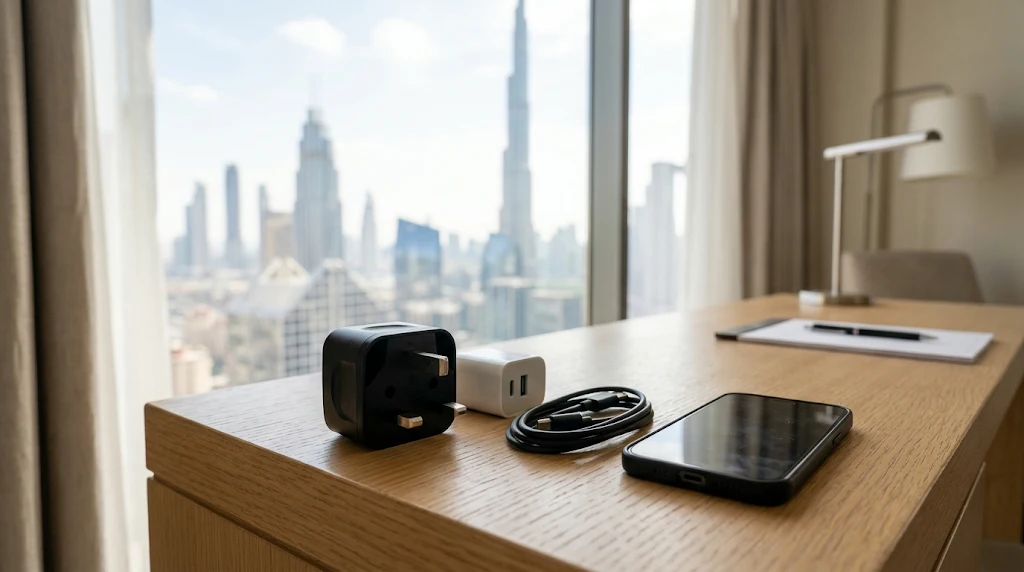
The UAE mainly uses Type G electrical plugs and sockets. This is the three-pin rectangular plug design also commonly associated with the United Kingdom.
A Type G plug has three rectangular pins arranged in a triangular pattern. The top pin is the earth pin, while the two lower pins connect to the electrical supply.
Visitors from countries that use different plug designs may find that their chargers do not fit directly into UAE wall sockets.
What Does a Type G Plug Look Like?
A standard Type G plug has:
- Three rectangular metal pins
- Two lower pins for the electrical supply
- One upper earth pin
- A rectangular plug body
Hotels, apartments, shopping facilities and other buildings commonly provide sockets compatible with this plug type.
However, socket arrangements can vary between properties. If you are staying in an older building or a hotel with unusual socket arrangements, check with reception before relying on a particular adapter.
What Is the Voltage in the UAE?
The standard electricity supply in the UAE is generally 230 volts (V) with a frequency of 50 hertz (Hz).
These figures are important because electrical devices are designed to operate within particular voltage and frequency ranges.
A plug adapter changes the physical connection between a device’s plug and a wall socket. It does not automatically change the voltage supplied to the device.
That distinction is important for visitors bringing appliances from countries with different electrical standards.
UAE Electricity at a Glance
| Electrical Detail | UAE Standard |
|---|---|
| Common plug type | Type G |
| Nominal voltage | 230 V |
| Frequency | 50 Hz |
| Socket design | Three rectangular pins |
| Common travel requirement | Type G-compatible adapter, if your plug differs |
Do Tourists Need a Travel Adapter for the UAE?
You may need a travel adapter if the plug on your phone charger, laptop power supply or other device is not compatible with a Type G socket.
For example, travellers from countries that commonly use Type A, Type C or Type I plugs may need an adapter to connect their devices to UAE sockets.
A suitable adapter should:
- Accept the plug design used by your device
- Fit securely into a Type G socket
- Support the electrical rating required by your device
- Be from a reliable manufacturer
- Be suitable for the type of device you intend to connect
A universal travel adapter can be useful for people visiting several countries, but check its supported plug types and electrical rating before buying it.
Is a Plug Adapter the Same as a Voltage Converter?
No. These are two different products.
A plug adapter changes the shape of the connection so that a plug can fit into a different socket.
A voltage converter changes the electrical voltage supplied to a device.
Many modern phone and laptop chargers support a wide input-voltage range, so they may only need a suitable plug adapter. However, some appliances are designed for a single voltage and may require a compatible voltage converter.
Never assume that an adapter also converts voltage.
Can You Charge Your Phone in Dubai and Other UAE Cities?
Most modern smartphones can be charged in the UAE when used with a compatible charger and adapter.
Many phone charging adapters are designed for a wide input range, commonly marked as 100–240 V and 50/60 Hz. If your charger’s label confirms that range, it is generally compatible with the UAE’s standard supply.
Before travelling, check the small electrical information printed on your charger.
Look for a marking such as:
Input: 100–240 V ~ 50/60 Hz
If the charger supports the UAE voltage and frequency, you generally need only a suitable plug adapter if its plug does not fit the local socket.
Do not rely only on the phone brand or model. Check the actual charger or power supply you intend to use.
Can You Use a Laptop Charger in the UAE?
Many modern laptop chargers are designed to work with a wide range of input voltages.
If the charger label states that it supports 100–240 V and 50/60 Hz, it is generally suitable for use with the UAE electricity supply.
You may still need a Type G travel adapter if the charger’s plug has a different shape.
Before connecting your laptop:
- Read the input-voltage information on the charger.
- Check that the listed range includes 230 V.
- Confirm that the frequency rating supports 50 Hz.
- Use a suitable, undamaged plug adapter if required.
- Check that the connection is secure.
If the charger has a different voltage rating, consult the device manufacturer or a qualified electrical professional before using it.
What About Hair Dryers, Straighteners and Other Appliances?
Personal-care appliances need more attention because some models have different voltage requirements.
Hair dryers, straighteners, electric shavers and similar products may be designed for a particular electrical supply or may support multiple voltages.
Check the appliance label for its input rating before connecting it.
Single-Voltage Appliances
A single-voltage appliance may be designed for use only with a particular voltage.
If its rating does not support 230 V, using a simple plug adapter will not make it compatible with the UAE supply.
Do not connect it until you have confirmed that an appropriate voltage-conversion solution is available and suitable for that appliance.
Dual-Voltage Appliances
Some appliances support more than one voltage or have a selectable voltage setting.
If the appliance label includes 220–240 V or a wider range that covers 230 V, it may be suitable for use in the UAE.
Follow the manufacturer’s instructions, including any voltage-selection requirements.
Where Can You Buy a UAE Travel Adapter?
Travellers can look for Type G travel adapters through electronics retailers, travel-accessory shops and other suitable stores.
Some airport shops may also sell travel adapters, but availability and prices can vary.
Before buying one, check:
- Whether it supports Type G sockets
- Whether it accepts your home-country plug
- Its maximum electrical rating
- Whether it has appropriate safety features
- Whether it is suitable for your intended device
- Whether the product is from a reputable manufacturer
If you are travelling with several devices, check whether a multi-port adapter or USB charging solution is appropriate for your equipment. Do not exceed the adapter’s stated power limit.
It is usually easier to arrange a compatible adapter before departure rather than searching for one after arriving.
Do UAE Hotels Provide Travel Adapters?
Some hotels may have spare travel adapters or compatible sockets available for guests, but this is not guaranteed.
If you forget your adapter, contact the hotel reception and ask whether one is available.
Before travelling, you can also send the hotel a short message asking:
- Do guest rooms have Type G power sockets?
- Are universal adapters available?
- Is there a charge for borrowing one?
- Are USB charging ports provided in the room?
Do not assume that every hotel offers free adapters or USB charging facilities.
When planning your accommodation, our UAE Hotel Check-In and Check-Out Guide can also help you prepare for other practical parts of your stay.
Can You Use a Power Bank in the UAE?
A power bank can be useful when travelling around Dubai, Abu Dhabi and other UAE destinations.
It allows you to charge compatible devices without needing to find a wall socket immediately.
However, power banks contain rechargeable batteries and are subject to airline baggage and battery rules.
Before flying:
- Check your airline’s current power-bank policy.
- Review the permitted battery capacity.
- Keep the power bank in the baggage category required by your airline.
- Protect it from damage.
- Do not use a damaged or swollen battery.
Airline rules can differ, so confirm the latest requirements with your carrier before departure.
Electrical Safety Tips for Tourists
Using the correct adapter and checking device compatibility can help prevent avoidable electrical problems.
Use a Good-Quality Adapter
Choose an adapter from a reputable manufacturer. Avoid damaged, loose or poorly made products.
A plug that does not fit securely should not be forced into a socket.
Do Not Overload Sockets
Avoid connecting too many high-power appliances through one adapter or extension device.
Check the adapter’s maximum rating and follow its instructions.
Keep Electrical Equipment Away from Water
Do not use electrical chargers or appliances near wet surfaces, sinks, showers or other sources of water.
Keep your hands and the surrounding area dry when connecting or disconnecting equipment.
Check Cables and Chargers
Do not use chargers with damaged cables, exposed wires, cracked cases or loose connections.
Replace damaged equipment rather than attempting to continue using it.
Do Not Force an Incompatible Plug
If your plug does not fit, use a compatible adapter. Never try to modify the plug or socket yourself.
If you are unsure whether an appliance is suitable for the UAE supply, ask the manufacturer or a qualified professional.
What Should You Pack for Charging Devices in the UAE?
A little preparation can make charging your electronics easier during your holiday.
Consider packing:
- A Type G travel adapter, if required
- Your original phone charger
- Your laptop charger
- A suitable charging cable
- A compatible power bank
- A multi-port USB charger, if needed
- A protective pouch for cables and accessories
Check the electrical ratings of your equipment before placing it in your luggage.
For a broader preparation checklist, see our Dubai Packing List and review the electronics section before leaving home.
Common Mistakes to Avoid
Buying an Adapter Without Checking Its Plug Type
Not every travel adapter supports Type G sockets. Check the product description and plug compatibility before purchasing.
Assuming an Adapter Converts Voltage
A plug adapter changes the connection shape. It does not automatically convert 230 V into another voltage.
Ignoring the Charger Label
The input rating printed on a charger or appliance is more useful than guessing based on the device’s brand.
Using a Damaged Adapter
Loose or damaged adapters should not be used. Choose a properly rated product in good condition.
Forgetting Airline Battery Rules
Power banks and other spare batteries may have specific airline restrictions. Check the rules before packing them.
Frequently Asked Questions About UAE Plug Type and Voltage
What plug type does the UAE use?
The UAE mainly uses Type G plugs and sockets, which have three rectangular pins arranged in a triangular pattern.
Is the UAE voltage 220 V or 230 V?
The standard nominal electricity supply in the UAE is generally 230 V at 50 Hz. Always check your device’s input rating before connecting it.
Do I need a travel adapter for Dubai?
You need a travel adapter if your device’s plug is not compatible with a Type G socket. The requirement depends on the plug used in your home country.
Can I charge my iPhone in the UAE?
You can generally charge a compatible modern phone charger in the UAE if its input rating supports 230 V and 50 Hz. You may need a Type G plug adapter.
Can I use my UK plug in the UAE?
UK-style Type G plugs are compatible with the common UAE socket design. Check that your device’s voltage rating also supports the UAE supply.
Can I use a US charger in the UAE?
Some US chargers support 100–240 V and 50/60 Hz, while others may have different ratings. Check the charger label. A suitable Type G adapter may be needed.
Do hotels in Dubai provide adapters?
Some hotels may provide adapters or have compatible charging facilities, but availability is not guaranteed. Contact your hotel before arrival.
Is a voltage converter necessary in the UAE?
A voltage converter is not necessary for every device. Many modern chargers support 100–240 V. Appliances that do not support 230 V may require a suitable converter, subject to the manufacturer’s guidance.
Final Thoughts
Understanding the UAE plug type and voltage before travelling can help you avoid charging problems during your holiday.
The UAE generally uses Type G sockets with a 230 V, 50 Hz electricity supply. Visitors whose plugs have a different design may need a suitable travel adapter, while devices with different voltage requirements need additional compatibility checks.
Read the labels on your chargers and appliances, choose reliable adapters and follow basic electrical safety precautions.
With a little preparation, you can keep your essential devices ready to use throughout your UAE trip.