Planning a holiday in a new city involves more than choosing attractions and booking accommodation. For travellers who use a wheelchair, it is also important to understand transport options, building access, hotel facilities and the distance between different places.
Dubai has modern roads, large shopping centres, hotels and visitor attractions, but accessibility can vary from one location to another. A place may have step-free entrance access while another part of the same venue may have different arrangements.
This wheelchair accessible Dubai guide explains how visitors can plan a more comfortable trip, choose suitable transport, check attractions before visiting and avoid common accessibility problems.
Whether you are travelling independently, with family or with a companion, a little preparation can make exploring Dubai easier.
Is Dubai Wheelchair Accessible for Tourists?
Dubai has many modern public spaces and visitor facilities, and wheelchair users can find accessible options across the city. However, accessibility is not identical everywhere.
Some hotels, shopping centres, transport facilities and attractions provide features such as ramps, lifts, accessible toilets or step-free routes. Other places may have limited access in certain areas.
Before visiting a location, check the specific facilities rather than assuming that the entire venue is wheelchair accessible.
Useful details to confirm include:
- Whether the main entrance is step-free
- Whether lifts are available
- Whether accessible toilets are provided
- Whether the route between the entrance and main facilities is suitable
- Whether parking spaces for visitors with disabilities are available
- Whether staff can provide accessibility assistance
- Whether advance arrangements are required
The most important step is to confirm your individual requirements directly with the hotel, attraction or transport provider before travelling.
Wheelchair Accessible Transport in Dubai
Transport planning is an important part of an accessible holiday. Dubai has several transport options, but their suitability can depend on the route, vehicle and station facilities.
1. Dubai Metro
The Dubai Metro can be useful for travelling between several major areas of the city. Stations and trains have accessibility features, but visitors should check the facilities and route at their chosen stations.
Before using the Metro:
- Check whether your departure and destination stations have suitable step-free access.
- Look for lifts and accessible passenger routes.
- Allow extra time when changing lines or moving through a large station.
- Ask station staff for assistance if you are unsure where to go.
- Check service information before beginning your journey.
A route that looks simple on a map may involve a longer station transfer or walking distance. Planning the complete journey is therefore important.
Read our Dubai Public Transport Guide for an overview of the city’s public transport options.
2. Dubai Taxis
A regular taxi may not be suitable for every wheelchair user, particularly if the wheelchair needs to remain occupied during the journey.
If you need a vehicle with wheelchair-accessible entry, confirm the vehicle type before booking. Ask whether the service can accommodate your wheelchair and whether you can remain seated in it during the trip.
When arranging transport, explain your requirements clearly:
- The type of wheelchair you use
- Whether it folds
- Whether you need a ramp or lift
- Whether you need to remain in the wheelchair during the journey
- The number of passengers travelling with you
- Your pickup and drop-off locations
Do not assume that every taxi has the same accessibility equipment. Confirm the exact vehicle and arrangements before relying on a booking.
For general information about travelling around the city by taxi, read our Dubai Taxi Guide for Tourists.
3. Private Accessible Transport
Some visitors may prefer to arrange suitable private transport in advance, especially when travelling with family or visiting several attractions in one day.
Before confirming a booking, ask the provider for clear information about the vehicle’s accessibility features. A vehicle described as spacious is not necessarily wheelchair accessible.
Confirm the following:
- Whether it has a wheelchair ramp or lift
- Whether suitable wheelchair restraints are available
- Whether the passenger can remain in the wheelchair during travel
- Whether there is enough space for companions and luggage
- Whether the service covers all your planned destinations
Getting these details in writing can help prevent confusion on the day of travel.
Wheelchair Accessible Attractions in Dubai
Dubai has a wide variety of attractions, including shopping destinations, waterfront areas, cultural locations and modern landmarks.
However, accessibility can differ between individual buildings and outdoor areas. Check the specific entrance, route and facilities before making a visit.
1. Dubai Mall
Dubai Mall is a major shopping and entertainment destination with a large indoor layout.
Because the mall covers an extensive area, planning your visit can make a significant difference. Check the location of lifts, accessible toilets, entrances and the attractions you want to visit.
Useful planning tips include:
- Choose an entrance close to your intended destination.
- Check the mall’s accessibility information before arriving.
- Allow additional time for moving between different sections.
- Confirm access arrangements for any separately operated attraction.
- Ask customer service for directions to accessible facilities.
You may also want to explore our guide to the Best Places to Visit in Dubai for First-Time Visitors.
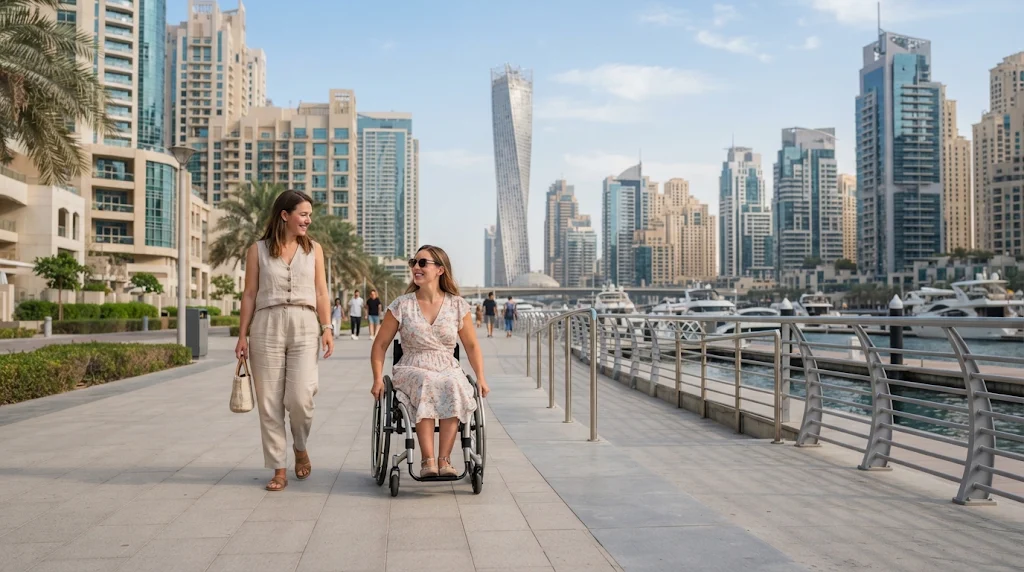
2. Dubai Marina
Dubai Marina is known for its waterfront surroundings, residential buildings, restaurants and leisure areas.
Some sections may be easier to navigate than others, depending on the surface, crowd levels, construction work and the exact route.
Before visiting, identify the specific restaurant, promenade section or destination you want to reach. Check whether the route has suitable surfaces and step-free access.
Visiting outside particularly busy periods may also make moving through crowded areas more comfortable.
3. Jumeirah Beach Areas
Dubai’s beach destinations can offer a different experience from indoor attractions. However, access to the beach itself may require more planning than reaching a nearby building or restaurant.
If you want to visit a beach, check whether the location offers accessible paths, suitable changing facilities, accessible toilets and any beach-access equipment.
Ask about the availability of these facilities for your intended visit date. Do not assume that every beach has the same arrangements.
4. Museum and Cultural Attractions
Museums and cultural venues can be enjoyable places to visit, but their accessibility features may differ.
Before booking, check:
- Step-free entry
- Lift access between floors
- Accessible visitor routes
- Seating or rest areas
- Accessible toilets
- Any special assistance arrangements
If a venue has several exhibition areas, ask whether all sections are accessible or whether some areas have restrictions.
How to Choose a Wheelchair Accessible Hotel in Dubai
Choosing suitable accommodation is one of the most important decisions for a comfortable trip.
A hotel may advertise accessible rooms, but you should confirm the exact facilities that match your needs before paying.
What to Check Before Booking
Ask the hotel about the following features:
Step-free entrance: Confirm whether you can enter the hotel without using stairs.
Accessible guest room: Ask whether the room is specifically designed for wheelchair users.
Bathroom layout: Check the shower arrangement, grab rails, toilet access and available turning space.
Lift access: Confirm that you can reach your room and the main hotel facilities using lifts.
Restaurant access: Ask whether the breakfast area and other dining facilities are accessible.
Swimming pool access: If using the pool is important to you, ask about the entrance, surrounding surfaces and any available assistance.
Parking: If you are travelling in a private vehicle, confirm the availability and location of accessible parking.
Ask for Confirmation Before Arrival
Photos and general descriptions may not provide enough information to determine whether a room will meet your needs.
Contact the hotel directly and explain the facilities you require. If possible, request written confirmation of the room type and accessibility arrangements.
Also ask whether the accessible room is actually reserved for your booking rather than simply being available on request.
Planning a Wheelchair Friendly Dubai Itinerary
A well-planned itinerary can reduce unnecessary travel and make your holiday more manageable.
Instead of visiting attractions across the city on the same day, consider grouping nearby destinations together.
Plan One Area at a Time
Choose attractions that are close to each other. This can reduce the number of transport journeys and make it easier to manage breaks.
For example, you might plan a day around a shopping destination and nearby indoor attractions, followed by a separate day for waterfront locations.
Check the Full Route
Do not check only whether the destination is accessible. Consider the complete journey from your hotel to the attraction.
This includes:
- The hotel entrance
- The route to the vehicle or station
- Transport boarding arrangements
- The destination entrance
- Movement inside the venue
- Access to toilets and dining areas
A destination may have good facilities, but an inaccessible route to reach it can still create difficulties.
Allow Extra Time
Avoid planning too many activities in one day. Allow time for transport, rest breaks, meals and unexpected delays.
A flexible schedule is often more comfortable than trying to follow a tightly packed itinerary.
Keep Important Information on Your Phone
Save hotel details, attraction addresses, booking confirmations and transport arrangements.
You can also keep written notes explaining your accessibility requirements. This may make communication easier when speaking with hotel or transport staff.
Useful Questions to Ask Before Visiting an Attraction
Before booking or travelling, contact the venue and ask specific questions.
| Question | Why It Matters |
|---|---|
| Is the main entrance step-free? | Helps confirm entrance access |
| Are lifts available? | Important for multi-level buildings |
| Are accessible toilets available? | Helps plan longer visits |
| Is the entire visitor route accessible? | Identifies possible restrictions |
| Is advance booking required for assistance? | Prevents last-minute problems |
| Is accessible parking available? | Useful for private transport |
| Are there any temporary access restrictions? | Helps avoid unexpected barriers |
Try to receive clear answers rather than relying only on a general statement that a venue is accessible.
Common Accessibility Challenges to Prepare For
Even in a modern city, visitors may encounter situations that require additional planning.
Long Distances Inside Large Buildings
Large malls, hotels and attractions can involve considerable distances between entrances, lifts and individual facilities.
Check the layout before visiting and plan rest stops where possible.
Busy Areas and Crowds
Popular attractions can become crowded, making movement more difficult.
Consider visiting at a quieter time and allow extra time for entering and leaving the venue.
Temporary Construction or Road Changes
Construction, maintenance and temporary closures can affect pedestrian routes and entrances.
Check for current access information before leaving your hotel.
Different Accessibility Standards
A hotel room, restaurant and transport vehicle may all have different facilities.
Always confirm each part of your journey separately instead of assuming that accessibility at one location guarantees accessibility elsewhere.
Practical Tips for Wheelchair Users Visiting Dubai
A few simple steps can help you prepare for your holiday:
- Contact your hotel before booking and confirm the exact room facilities.
- Check transport arrangements before travelling to an attraction.
- Save the addresses of your destinations on your phone.
- Confirm accessible toilet availability at places where you plan to spend several hours.
- Keep extra time between activities.
- Ask attractions about temporary closures or access restrictions.
- Carry any essential personal equipment and relevant travel documents.
- Share your itinerary with your travel companion if you are travelling with someone.
- Keep important booking confirmations available offline.
- Confirm arrangements again shortly before your visit if accessibility is essential to your plans.
For more general planning advice, read our Dubai Travel Tips for First-Time Visitors.
Frequently Asked Questions
Is Dubai wheelchair accessible?
Dubai has many modern facilities and visitor destinations with accessibility features. However, facilities vary by location, so visitors should confirm the exact arrangements before travelling.
Can wheelchair users use the Dubai Metro?
The Metro has accessibility features, but travellers should check their chosen stations, routes and transfer arrangements before starting a journey.
Are Dubai taxis wheelchair accessible?
Some transport services may offer vehicles designed for wheelchair users. A standard taxi should not automatically be assumed to have a ramp or lift. Confirm the vehicle’s equipment and booking arrangements in advance.
Can I find wheelchair accessible hotels in Dubai?
Some hotels offer accessible rooms and facilities. Contact the hotel directly to confirm the room layout, bathroom features, lift access and other requirements before booking.
Are Dubai shopping malls wheelchair friendly?
Major shopping malls may provide facilities such as lifts and accessible toilets. Because each mall and attraction has its own layout, check the facilities and routes before visiting.
Can wheelchair users visit Dubai beaches?
Some beach locations may provide accessibility features, but facilities differ. Contact the beach operator or venue to ask about accessible paths, toilets and any available beach-access equipment.
Should I arrange accessible transport before arriving in Dubai?
If you need a specially equipped vehicle, arranging and confirming transport in advance is a sensible step. Make sure the provider understands your exact requirements.
What is the most important thing to check before visiting an attraction?
Check the complete route, including the entrance, internal pathways, lifts, toilets and transport arrangements. A general accessibility label may not explain whether the venue meets your individual needs.
Final Thoughts
Dubai offers many places that wheelchair users may be able to enjoy, but a comfortable visit depends on checking the details before travelling.
Start by choosing accommodation that meets your requirements, confirm suitable transport and contact attractions about their facilities. Plan nearby destinations together and allow enough time for travel and rest.
The most useful approach is to verify each part of your journey rather than assuming that every modern building or public area has the same accessibility arrangements.
With thoughtful planning and clear communication, visitors who use wheelchairs can make more informed choices and enjoy a better-organised trip to Dubai.