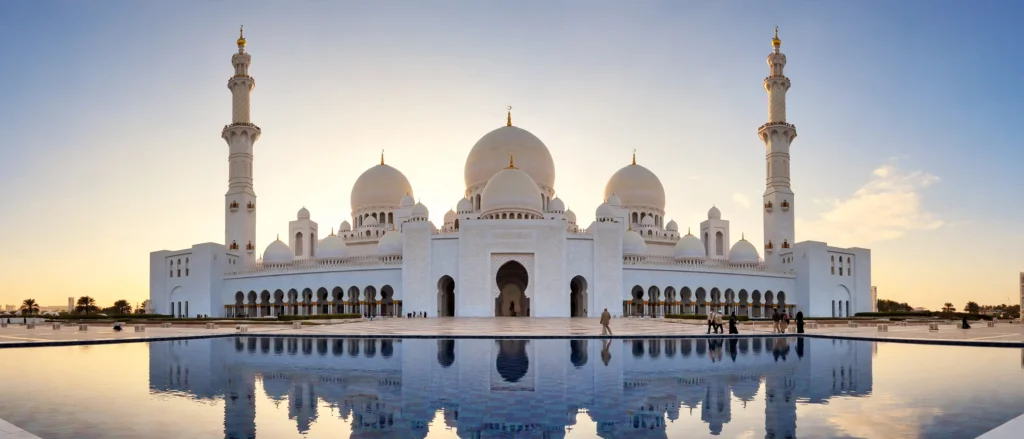
The Sheikh Zayed Grand Mosque is the one place in Abu Dhabi that almost every visitor puts at the top of their list, and it earns that place. White marble domes, four tall minarets, long reflecting pools and courtyards so bright they seem to glow — it is beautiful in photographs, and quieter and grander in person than any photograph suggests.
It is also a working mosque, not a museum. That is part of what makes a visit memorable, and it is why a little preparation matters. Entry is free, but you need to register in advance, dress to the mosque’s rules, and plan around prayer times and the Friday schedule. Get those three things right and the visit is easy. Get them wrong and you can lose an hour at the gate.
This guide covers what the mosque is, when to go, how to register, what to wear, what to see inside, and how to fit it into an Abu Dhabi day.
What is the Sheikh Zayed Grand Mosque?
The mosque stands at the entrance to Abu Dhabi City Island, on the western side of the Khor Al Maqta waterfront, so many visitors see its white domes from the road before they ever arrive. It is one of the largest mosques in the world and the grandest religious building in the United Arab Emirates, built as a place of worship and as a symbol of the country’s cultural heritage.
Inside, the scale is what stays with you: vast white marble courtyards, floral inlay work in coloured stone, gold-capped columns, and enormous crystal chandeliers hanging over the prayer halls. The main prayer hall holds one of the world’s largest hand-knotted carpets — about 5,700 square metres, made by more than a thousand artisans — and the chandeliers are among the largest ever made for a mosque. You do not need to know anything about Islamic architecture to enjoy it; you only need to slow down and look up.
Non-Muslim visitors are welcome, and the mosque is used to tourists. Staff at the entrance are helpful, signs explain the rules clearly, and free guided tours run every day. What the mosque asks in return is simple: respect. Keep your voice low, dress modestly, follow staff instructions, and remember that people around you may be praying.
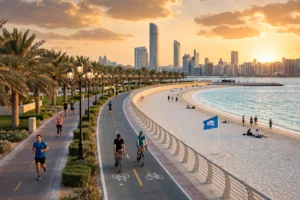
If you are planning a wider Abu Dhabi trip, start with our guide to the best places to visit in Abu Dhabi to see how the mosque fits alongside the Louvre, Qasr Al Watan and the Corniche.
Is entry free? Do you need to register?
Yes, entry is free for everyone. But free does not mean just turn up. Visitors need to register in advance on the mosque’s official website and get an online access pass before arriving. This is the step most first-time visitors miss, and it is the one that causes queues and disappointment at the gate.
Register before you leave your hotel, not at the entrance. The official site is where bookings are made, and it is also where you will find the current visitor arrangements, which can change around public holidays and Ramadan. If the website has trouble loading — something other visitors have reported — try again a little later rather than assuming you can register on arrival.
Children of all ages are welcome, and there is no ticket to buy. If you want a guided tour, the mosque offers complimentary cultural tours in English and Arabic, lasting about 30 to 45 minutes. They run from Monday to Sunday at 11:00 AM, 1:00 PM and 5:00 PM, and bookings are made through the mosque’s official website. A tour is the best way to understand what you are looking at — the symbolism of the design, the materials, and the story of the building — so if you can, join the 11:00 AM or 5:00 PM tour and let the rest of your day fit around it.
Opening hours
Opening hours follow a different pattern on Fridays, because Friday is the main congregational prayer day. As checked on 25 November 2026, the hours are:
- Monday to Thursday, Saturday and Sunday: 9:00 AM to 9:00 PM, last entry 8:30 PM.
- Friday: 9:00 AM to 12:00 PM, last entry 11:30 AM, and then again from 3:00 PM to 9:00 PM, last entry 8:30 PM.
The Friday midday closure is for prayers, and the mosque is closed to tourists during that window. If your only free day is a Friday, plan for the afternoon session and arrive well before the last entry time — the light in the late afternoon is also the best for photographs.
Hours can change around Ramadan, Eid and public holidays, so check the official site the day before you go rather than relying on a guide you read weeks ago. For the best season to plan around, see our guide to the best time to visit Abu Dhabi.
What to wear: the dress code
The dress code is strict, and staff do enforce it. This is the part of the visit where most tourists get turned back, so read it carefully.
For women: clothing must be loose-fitting, covering the body to the ankles, with sleeves that reach the wrists. Full hair coverage is required. Transparent, tight-fitting or revealing clothing is not allowed. A long, loose dress or abaya with a headscarf works well; leggings under a short top, sheer fabrics and sleeveless tops do not.
For men: clothing should cover the full length of the legs, and sleeveless shirts, transparent tops and tight-fitting clothing should be avoided. Shorts are not allowed.
Bring your own modest clothing if you can. Suitable clothing is also sold in the shops at Souq Al Jami’, the small market area at the mosque, where visitors buy abayas and arm sleeves if they arrive unprepared. Do not rely on rentals being available — buy or bring your own instead, and wear it from the start rather than changing at the gate.
Two more practical points: you will remove your shoes before entering the carpeted prayer areas, so wear shoes that are easy to slip off and on, and carry a small bag rather than a large backpack — large bags can slow you down at security and are not welcome inside the halls.
For what to pack generally, our Dubai packing list covers modest clothing for religious sites as well as the light layers you will want for air-conditioned spaces.
The best time to visit
The best times are early morning, around 9:00 AM when the mosque opens, or late afternoon, around 4:00 PM. Mornings are quieter and cooler, and the white marble is at its brightest. Late afternoon is the photographer’s choice: the low sun warms the marble to gold, and if you stay into the evening the mosque is lit up beautifully after dark.
Midday in the cooler months (November to March) is comfortable enough, but the courtyards have little shade, so bring water, sunglasses and sun protection even in winter. In summer, treat the mosque as a morning or evening visit only — the marble reflects heat and glare, and a midday walk across the courtyard is hard work.
For the single best photograph, walk across the road to Wahat Al Karama, the memorial park opposite the mosque. From there you get the full view of the domes and minarets across the water, without other visitors in the frame. Inside, the reflecting pools give you the classic mirror shot of the domes, and the colonnades frame the courtyard beautifully. Photograph the building and the details freely, but do not photograph people — especially worshippers — without permission, and follow any photography restrictions posted inside.
What to see inside
Give yourself at least an hour and a half, and two hours if you join a guided tour. A rushed twenty-minute visit misses the point of the place.
Start outside, in the courtyards and around the reflecting pools, where the scale of the building becomes clear. Then move inside through the main entrance hall, where the columns with gold floral capitals lead you towards the prayer halls. The main prayer hall is the highlight: the hand-knotted carpet, the chandeliers, the domed ceiling and the mihrab wall, all in white, gold and soft colour. The smaller prayer halls are quieter and worth a look too.
Look down as well as up. The marble inlay — flowers and patterns set into the floors and walls in coloured stone — is some of the finest craft in the building, and it is easy to walk past without noticing. The courtyards, the arches and the play of light through the colonnades are all part of the design, not decoration added afterwards.
If you are visiting with children, the guided tour keeps them engaged better than a self-guided wander, and the open courtyards give them space. Keep voices low throughout, and explain before you go in that this is a place of worship first and a tourist attraction second — that one sentence makes the whole visit smoother.
How to get there
The mosque is on the western edge of Abu Dhabi city, near the Maqta Bridge on the road from Dubai. If you are coming from Dubai, it is usually the first major stop in the city, which makes it a natural start to an Abu Dhabi day trip. Our guide on how to travel from Dubai to Abu Dhabi covers the bus, taxi and car options and the roughly 90-minute to two-hour journey.
Once in Abu Dhabi, a taxi is the simplest way to reach the mosque, and most drivers know it well. Public buses also serve the area, but check the current route before relying on one. If you are staying overnight, choose your base with the mosque in mind — our guide to where to stay in Abu Dhabi compares the city centre, Corniche and Saadiyat Island, and the city centre is usually the most practical base for a mosque-first itinerary.
A simple half-day plan
- 9:00 AM: Arrive at opening, registered in advance, dressed to the code. Walk the courtyards and pools while it is quiet.
- 11:00 AM: Join the free guided cultural tour for the story behind the building.
- 12:30 PM: Leave the mosque and have lunch in the city. Try something local — our UAE food guide for tourists explains the dishes to look for, from machboos to luqaimat.
- Afternoon: Pair the mosque with one more nearby stop, such as Qasr Al Watan or the Corniche, rather than trying to cross the whole city. Our 2-day Abu Dhabi itinerary shows how the mosque anchors day one.
- Evening: If you want the lit-up view, return to the Wahat Al Karama side after dark — it is a different building at night, and it costs nothing to see.
If you only have one day in Abu Dhabi, the mosque plus one museum or palace and a Corniche walk is a full, satisfying day. Do not add a third major attraction on top; the distances in Abu Dhabi are longer than they look on a map.
Mistakes to avoid
- Arriving without registering. This is the most common mistake. Register online before you go.
- Wearing the wrong clothes. Shorts, sleeveless tops, tight or sheer clothing and uncovered hair for women will stop you at the entrance. Dress for the mosque, not for the beach.
- Visiting at Friday midday. The mosque is closed to tourists between the morning and afternoon sessions on Fridays.
- Rushing. The mosque rewards slow looking. Budget two hours, not twenty minutes.
- Photographing worshippers. Photograph the architecture, not the people praying.
- Planning it as a midday summer stop. Go early or late, and carry water.
FAQ
Is the Sheikh Zayed Grand Mosque free to visit? Yes, entry is free. You do need to register in advance on the mosque’s official website for an access pass, and guided tours are also free.
What are the opening hours? Monday to Thursday, Saturday and Sunday: 9:00 AM to 9:00 PM, last entry 8:30 PM. Friday: 9:00 AM to 12:00 PM and 3:00 PM to 9:00 PM. Hours can change on holidays, so check before you go.
What should women wear? Loose-fitting clothing covering the body to the ankles, sleeves to the wrists, and full hair coverage. Transparent, tight or revealing clothing is not allowed.
Can men wear shorts? No. Men should wear full-length trousers and avoid sleeveless or transparent tops.
Do I need to book a guided tour? No, but the free 30 to 45-minute cultural tours (11:00 AM, 1:00 PM and 5:00 PM) are worth joining, and they are booked through the mosque’s official website.
Is photography allowed? Photography of the building is generally allowed, but follow posted restrictions, do not photograph worshippers, and respect prayer times and staff instructions.
How long should I spend there? Allow at least 90 minutes, and two hours if you join a tour. A quick visit does not do the building justice.
Can children visit? Yes, children of all ages are welcome. Keep them close, keep voices low, and consider the guided tour to keep them engaged.
Final thoughts
The Sheikh Zayed Grand Mosque is the kind of place that makes a trip to Abu Dhabi feel complete. It is free, it is open to everyone, and it asks only for a little respect and preparation in return. Register in advance, dress modestly, go early or late, and give it the time it deserves. For more ideas on what to pair it with, see our guide to the best things to do in Abu Dhabi — the mosque is the first item on that list for a reason.