Ramadan in Dubai is one of the most atmospheric times to visit the city — and one of the most misunderstood. Many first-time visitors worry that everything will be closed, that they will not be allowed to eat, or that they should avoid travelling during the holy month altogether. None of that is true. With a little planning, Ramadan can be one of the best times to experience Dubai: quieter days, spectacular evenings, and a side of the city that the ordinary tourist season never shows.
In 2027, Ramadan falls in a particularly good window. It is expected to run from about Monday 8 February to early March, right in the middle of the cool winter season, when daytime temperatures are usually in the mid-20s to low 30s. That means the outdoor Dubai that summer visitors miss — the creek, the souks, the desert, the waterfront walks — is fully open during Ramadan 2027, and the evenings after sunset are the liveliest time of the whole year.
This guide explains the 2027 dates and how they are confirmed, what actually changes for tourists, what stays open, where to experience iftar, and how to plan your days with respect for the month.
When is Ramadan 2027 in Dubai?
Ramadan follows the lunar calendar, so it moves about 11 days earlier every year. Astronomical projections in the UAE indicate that Ramadan 2027 is likely to begin on or around Monday 8 February 2027 and continue for 29 or 30 days into early March. Eid Al Fitr, which marks the end of Ramadan, is expected to fall around 9 or 10 March 2027.
Treat those dates as a forecast, not a fixed public holiday. Astronomers can predict when the new crescent moon will be visible, but in the UAE the start of Ramadan is only confirmed by an official moon-sighting committee, which meets shortly before the expected date. One source (Wego) lists a slightly earlier start of Saturday 6 February 2027 with Eid on 8 March — an outlier against the 8 February date that most UAE sources agree on — which is exactly why you should re-check the official announcement a week before you travel if your trip touches the first or last days of the month. Your flights and hotel bookings will not move; only the exact start of reduced working hours, the first evening of iftar meals, and the timing of the Eid public holidays can shift by a day.
The same dates apply in our guide to the best time to visit Abu Dhabi — Ramadan 2027 falls in the same February–March window across the whole UAE, and the same advice about checking the moon sighting applies everywhere in the country.
What is Ramadan, in plain words?
Ramadan is one of the five central pillars of Islam. During the month, capable adult Muslims abstain from food, drink, smoking and certain other physical pleasures from dawn to sunset, focusing instead on prayer, charity and time with family. The fast is broken at sunset with a meal called iftar, traditionally begun with dates and a drink, and there is a second meal called suhoor before dawn.
For visitors, the useful thing to understand is the daily rhythm the fast creates: quiet, slow mornings, a very quiet afternoon, and then an enormous surge of life from sunset until late at night. Plan your days around that rhythm and Ramadan feels easy. Fight it — by booking a full day of midday walking tours, for example — and it feels frustrating for no reason.
What changes for tourists — and what does not
You are not required to fast. This is the worry most visitors have, and the answer is simple: non-Muslim tourists do not fast, and nobody expects them to.
Restaurants and cafes serve non-fasting guests through the day. Malls, attractions and supermarkets keep normal hours. In Dubai, the official portal says there are no specific restrictions for non-Muslims, and restaurants operate as normal — you can eat and drink during the day. Not eating, drinking or smoking in public during fasting hours is described as an act of kindness, not a ban. Rules in malls have relaxed in recent years: in 2025, media reported that eating and drinking were allowed in all parts of malls in Dubai and Abu Dhabi. Other emirates can keep different rules, so be a little more discreet outside Dubai, and always follow signs at individual venues.
Working hours are cut by two hours by law. Government offices, many companies and schools shift to shorter schedules — typically around 9:00 AM to 2:00 PM for government and banks — so everyone is home well before iftar. That means the city empties in the afternoon and fills up again after sunset.
Malls shift their hours. A typical pattern is shops open from about 10:00 AM to 1:00 PM, then again from 7:00 PM to 1:00 AM. Most malls in Dubai stay open until 1:00 AM during Ramadan, and food courts, cafes and restaurants keep running.
Museums and galleries often open in the evening, sometimes from 8:00 PM to midnight. Check the specific venue — an evening museum visit can be a lovely, quiet way to spend a Ramadan night.
Public transport runs later. Dubai Metro and Abu Dhabi buses run until at least 1:00 AM during Ramadan, and Friday service begins after 2:00 PM. Taxis, on the other hand, are hard to find around sunset, because many drivers are breaking their fast — allow extra time for evening journeys, and book a taxi before sunset rather than after it.
Live music softens. After Taraweeh prayers, loud music is discouraged, and many venues keep entertainment low-key. Smoking and vaping are not permitted in daylight hours, though designated areas reopen after iftar.
Dress modestly in public spaces, covering shoulders to knees. This is good advice in the UAE at any time of year, and it matters more during Ramadan. For packing, our Dubai packing list covers modest clothing for cultural and religious sites.
The best Ramadan experiences for visitors
The iftar cannon. The single best thing to do on a Ramadan evening is to stand near the iftar cannon at sunset. A cannon is fired at the moment the fast breaks — a tradition known locally as Midfa Al Iftar — at several public sites across the city, including Burj Park in Downtown Dubai, Expo City Dubai and Kite Beach. It is free, it takes about ten minutes, and the atmosphere in the hushed few seconds before it goes off is the thing visitors remember most. Check the current firing locations when you arrive, because the sites can change.
A hotel iftar. Every large hotel lays on an iftar buffet at sunset, and many build a Ramadan tent for the month. This is the full version of the meal, sitting down: dates, soups, grills, rice dishes, sweets and Arabic coffee, with families and friends sharing long tables. Book ahead — the popular hotel iftars fill up, especially on weekends. It is also the easiest way to try Ramadan food properly, including dishes that appear mainly during the month. Our UAE food guide for tourists explains the dishes to look for — harees and luqaimat are especially associated with Ramadan.
Suhoor, the meal most visitors never see. The late meal before dawn is a quieter, more social affair than iftar, running from around midnight into the early hours, often with shisha and live oud music. Some hotels and cafes keep suhoor service until Fajr. If you are a night owl, this is the most local experience Ramadan offers.
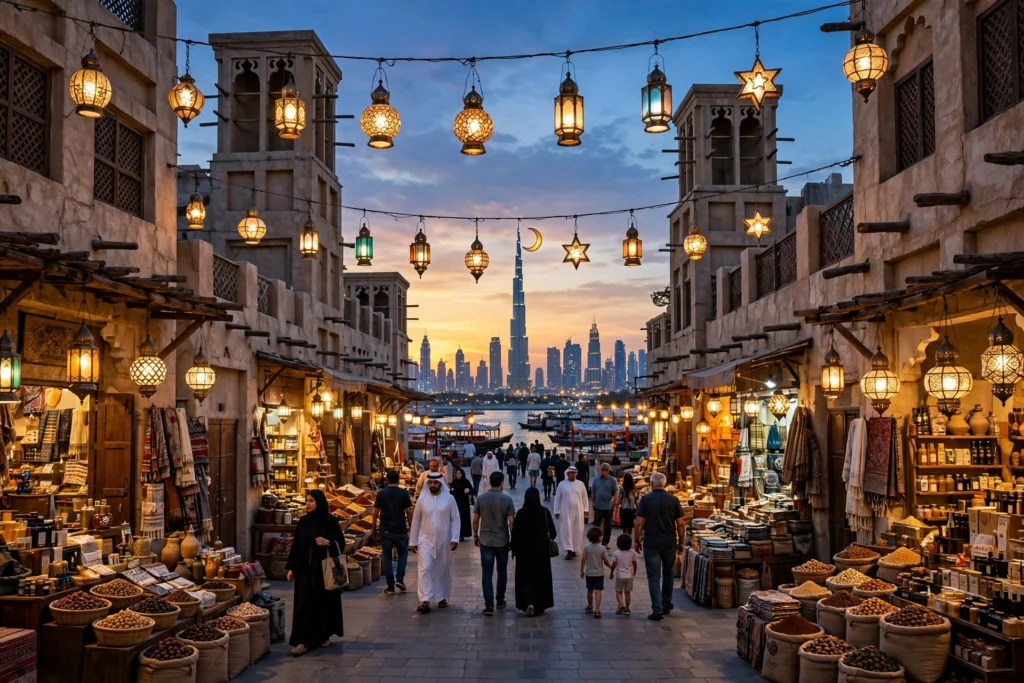
Old Dubai after dark. The historic districts around the creek are at their best during Ramadan, with the mosques full at prayer times and the lanes busy late. Walk Al Fahidi and the souks after iftar, when the heat has gone and the lights are on. For the daytime version of the same walk, see our 3-day Dubai itinerary — the Old Dubai day works even better as an evening during Ramadan.
Hai Ramadan at Expo City. The Ramadan festival at Expo City Dubai runs through the month with food, performances and family activities into the late evening. Check the current programme before you go.
A practical Ramadan day plan
Here is a day that works with the month instead of against it:
- Morning (9:00 AM – 12:00 PM): Sightseeing while it is cool and quiet. This is the best time for outdoor attractions — the creek, the souks, a desert safari morning departure. Our Dubai desert safari guide explains the morning, evening and overnight options.
- Afternoon (12:00 PM – 5:00 PM): Go indoors. Malls, museums, your hotel pool, a spa — this is the quiet part of the day, and fighting it with a long outdoor walk is the one mistake that makes Ramadan feel hard.
- Sunset: Be at the iftar cannon, or at your hotel iftar booking, a little before sunset. Taxis are scarce at this hour, so travel early.
- Evening (7:00 PM – 1:00 AM): This is when Dubai comes alive. Dinner, shopping, the creek, the waterfront — the city is at its busiest and most enjoyable after dark, and the Metro runs late.
- Late night: If you have the energy, try a suhoor. If not, sleep well — the next morning starts quietly again.
For costs, Ramadan can be good value: hotels are often cheaper than the Christmas and New Year peak, and many restaurants offer iftar deals. Our Dubai travel budget guide will help you plan the numbers, and our Dubai travel tips for first-time visitors cover the documents, transport and etiquette basics.
Ramadan with children and older travellers
Ramadan is a good time to visit with children, because the cooler February weather makes outdoor time comfortable and the evening atmosphere is festive rather than formal. Keep the same rules as any UAE trip: water, sun protection, breaks, and no long midday walks. Older travellers will appreciate the slower pace of the mornings and the fact that attractions are quieter during the day.
One caution: if you are travelling with someone who needs regular food or medication during the day, plan around it. Hotels and mall restaurants serve non-fasting guests, but smaller cafes outside tourist areas may be closed or curtained during the day. Carry what you need, and eat in the places that are clearly open.
What to avoid
- Eating, drinking or chewing gum openly in public during the day in front of people who are fasting. It is discouraged out of respect, even where it is not banned.
- Loud music and noisy behaviour after Taraweeh prayers.
- Booking a taxi at sunset without allowing extra time — drivers are breaking their fast and demand is high.
- Assuming everything is closed. It is not. Malls, attractions and restaurants are open; only the rhythm has changed.
- Planning a packed midday schedule. The afternoon is for indoors.
- Wearing revealing clothing in public places during the holy month.
FAQ
When is Ramadan 2027 in Dubai? Ramadan 2027 is expected to begin on or around Monday 8 February 2027 and last 29 or 30 days, with Eid Al Fitr expected around 9 or 10 March 2027. These are forecasts — the official start is confirmed by the moon-sighting committee.
Do tourists have to fast during Ramadan in Dubai? No. Non-Muslim tourists are not required to fast. Restaurants and cafes serve non-fasting guests during the day.
Are restaurants open during Ramadan in Dubai? Yes. Many restaurants stay open during the day, and malls keep their food courts, cafes and restaurants running. Hotel iftar buffets serve the sunset meal every evening.
Are attractions open during Ramadan? Yes. Malls, attractions and museums keep operating, often with evening hours. The Metro and buses run until at least 1:00 AM.
Is Ramadan a good time to visit Dubai? For many visitors, yes — especially in 2027, when Ramadan falls in the cool winter season. Days are quieter, evenings are lively, hotel prices are often lower than the Christmas peak, and the iftar cannon, Ramadan tents and evening atmosphere are experiences you cannot get at any other time of year.
What should I wear during Ramadan in Dubai? Dress modestly in public, covering shoulders to knees, and follow the dress rules at mosques and religious sites.
Can I visit the desert during Ramadan? Yes. Morning and evening desert safaris run during Ramadan. Check the operator’s schedule, because departure times may shift around iftar.
What is iftar? Iftar is the meal that breaks the fast at sunset, traditionally begun with dates. Hotels, restaurants and homes across the city serve it, and the iftar cannon marks the moment.
Final thoughts
Ramadan 2027 gives visitors something the ordinary Dubai holiday does not: a city that slows down by day and comes alive by night, with traditions — the cannon, the iftar table, the lantern-lit streets of Old Dubai — that are free to witness and easy to join respectfully. Come for the winter weather, stay for the evenings, and plan your days around the rhythm of the month. If you are still choosing your dates, our guide to the best places to visit in the UAE in December covers the other end of the winter season, and the desert, the creek and the beaches will still be there in February — just quieter, cooler and more beautiful after dark.